
- Understand the four primary generic strategies.
- Know the two dimensions that are critical to defining business-level strategy.
- Know the limitations of generic strategies.
Why Examine Generic Strategies?
Business-level strategy addresses the question of how a firm will compete in a particular industry (Figure 5.2 “Business-Level Strategies”). This seems to be a simple question on the surface, but it is actually quite complex. The reason is that there are a great many possible answers to this question. Consider, for example, the restaurants in your town or city. Chances are that you live fairly close to some combination of McDonald’s, Earls, Boston Pizza, The Keg, and dozens of other national chains, and a variety of locally based eateries that have just one location. Each of these restaurants competes using a business model that is at least somewhat unique. When an executive in the restaurant industry analyzes her company and her rivals, she needs to avoid getting distracted by all the nuances of different firm’s business-level strategies and losing sight of the big picture.
One solution is to think about business-level strategy in terms of generic strategies. A generic strategy is a general way of positioning a firm within an industry. Focusing on one generic strategy allows executives to concentrate on the core elements of firms’ business-level strategies and avoid competing in the markets better served by other generic strategies. The most popular set of generic strategies is based on the work of Professor Michael Porter of the Harvard Business School and subsequent researchers that have built on Porter’s initial ideas (Porter, 1980).
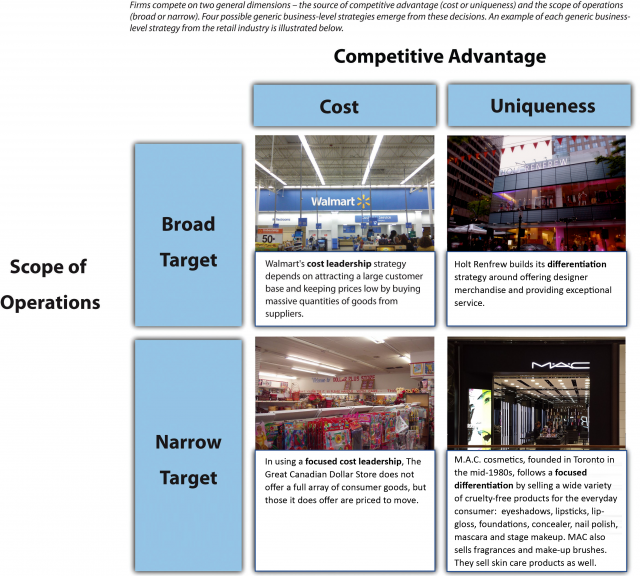
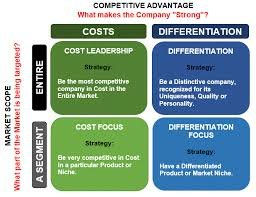
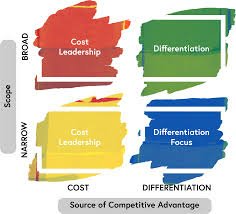
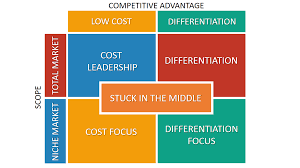
According to Porter, two competitive dimensions are the keys to business-level strategy. The first dimension is a firm’s source of competitive advantage: whether a firm seeks to gain an edge on rivals by keeping costs down or by offering something unique in the market. The second dimension is a firm’s scope of operations: whether a firm tries to target customers in general or seeks to attract just a segment of customers. Four generic business-level strategies emerge from these decisions: (1) cost leadership, (2) differentiation, (3) focused cost leadership, and (4) focused differentiation. In rare cases, firms are able to offer both low prices and unique features that customers find desirable. These firms are following a best-cost strategy. Firms that are not able to offer low prices or appealing unique features are referred to as “stuck in the middle,” where competition is greatest.
Understanding the differences that underlie generic strategies is important because different generic strategies offer considerably different value propositions to customers. A firm focusing on cost leadership will have a different value-chain configuration than a firm whose strategy focuses on differentiation. For example, marketing and sales for a differentiation strategy often requires extensive effort while some firms that follow cost leadership such as Denny’s are successful with limited marketing efforts. This chapter presents each generic strategy and the “recipe” generally associated with success when using that strategy. When firms follow these recipes, the result can be a strategy that leads to superior performance. But when firms fail to follow logical actions associated with each strategy, the result may be a value proposition configuration that is expensive to implement and does not satisfy enough customers to be viable.
Limitations of Generic Strategies
Examining business-level strategy in terms of generic strategies has limitations. Firms that follow a particular generic strategy tend to share certain features. For example, one way that cost leaders generally keep costs low is by not spending much on advertising. Not every cost leader, however, follows this path. While cost leaders such as Smitty’s Restaurants spend very little on advertising, Walmart spends considerable money on print and television advertising despite following a cost leadership strategy. Thus, a firm may not match every characteristic that its generic strategy entails. Indeed, depending on the nature of a firm’s industry, tweaking the recipe of a generic strategy may be essential to cooking up success.
 Generic Strategies