
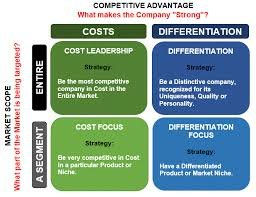
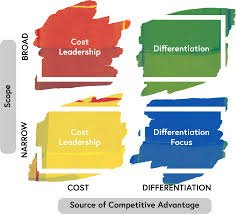
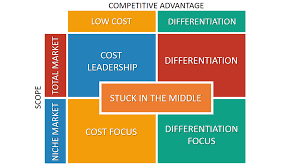
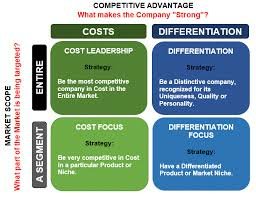
Porter called the generic strategies “Cost Leadership” (no frills), “Differentiation” (creating uniquely desirable products and services) and “Focus” (offering a specialized service in a niche market). … He then subdivided the Focus strategy into two parts: “Cost Focus” and “Differentiation Focus.”
Surveyj





Surveyj.com






Understanding Business-Level Strategy through “Generic Strategies”
- Understand the four primary generic strategies.
- Know the two dimensions that are critical to defining business-level strategy.
- Know the limitations of generic strategies.
Why Examine Generic Strategies?
Business-level strategy addresses the question of how a firm will compete in a particular industry (Figure 5.2 “Business-Level Strategies”). This seems to be a simple question on the surface, but it is actually quite complex. The reason is that there are a great many possible answers to this question. Consider, for example, the restaurants in your town or city. Chances are that you live fairly close to some combination of McDonald’s, Earls, Boston Pizza, The Keg, and dozens of other national chains, and a variety of locally based eateries that have just one location. Each of these restaurants competes using a business model that is at least somewhat unique. When an executive in the restaurant industry analyzes her company and her rivals, she needs to avoid getting distracted by all the nuances of different firm’s business-level strategies and losing sight of the big picture.
One solution is to think about business-level strategy in terms of generic strategies. A generic strategy is a general way of positioning a firm within an industry. Focusing on one generic strategy allows executives to concentrate on the core elements of firms’ business-level strategies and avoid competing in the markets better served by other generic strategies. The most popular set of generic strategies is based on the work of Professor Michael Porter of the Harvard Business School and subsequent researchers that have built on Porter’s initial ideas (Porter, 1980).
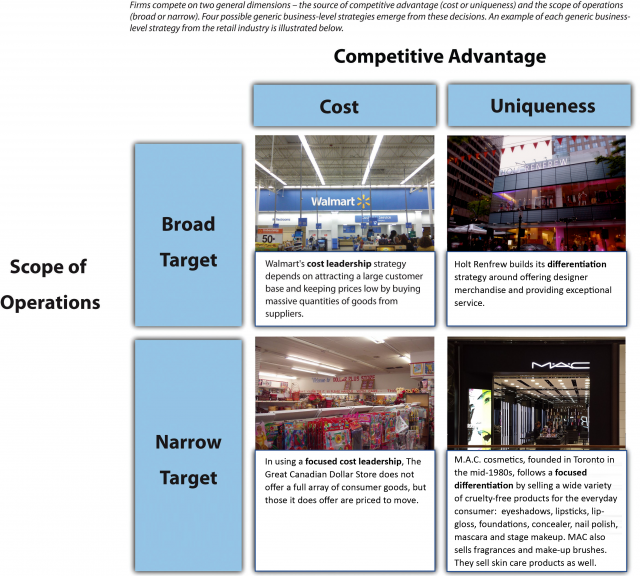
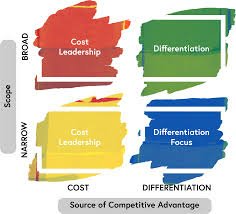
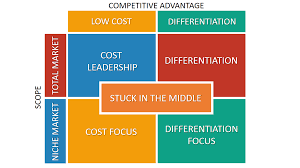
According to Porter, two competitive dimensions are the keys to business-level strategy. The first dimension is a firm’s source of competitive advantage: whether a firm seeks to gain an edge on rivals by keeping costs down or by offering something unique in the market. The second dimension is a firm’s scope of operations: whether a firm tries to target customers in general or seeks to attract just a segment of customers. Four generic business-level strategies emerge from these decisions: (1) cost leadership, (2) differentiation, (3) focused cost leadership, and (4) focused differentiation. In rare cases, firms are able to offer both low prices and unique features that customers find desirable. These firms are following a best-cost strategy. Firms that are not able to offer low prices or appealing unique features are referred to as “stuck in the middle,” where competition is greatest.
Understanding the differences that underlie generic strategies is important because different generic strategies offer considerably different value propositions to customers. A firm focusing on cost leadership will have a different value-chain configuration than a firm whose strategy focuses on differentiation. For example, marketing and sales for a differentiation strategy often requires extensive effort while some firms that follow cost leadership such as Denny’s are successful with limited marketing efforts. This chapter presents each generic strategy and the “recipe” generally associated with success when using that strategy. When firms follow these recipes, the result can be a strategy that leads to superior performance. But when firms fail to follow logical actions associated with each strategy, the result may be a value proposition configuration that is expensive to implement and does not satisfy enough customers to be viable.
Limitations of Generic Strategies
Examining business-level strategy in terms of generic strategies has limitations. Firms that follow a particular generic strategy tend to share certain features. For example, one way that cost leaders generally keep costs low is by not spending much on advertising. Not every cost leader, however, follows this path. While cost leaders such as Smitty’s Restaurants spend very little on advertising, Walmart spends considerable money on print and television advertising despite following a cost leadership strategy. Thus, a firm may not match every characteristic that its generic strategy entails. Indeed, depending on the nature of a firm’s industry, tweaking the recipe of a generic strategy may be essential to cooking up success.
Chapter 5: Selecting Business-Level Strategy
After reading this chapter, you should be able to understand and answer the following questions:
- Why is an examination of generic strategies valuable?
- What are the four main generic strategies?
- What is a best-cost strategy?
- What does it mean to be “stuck in the middle”?
The Competition Takes Aim at Target

On January 13, 2011, Target Corporation announced its intentions to operate stores outside the United States for the first time. The plan called for Target to enter Canada by purchasing existing leases from a Canadian retailer (Zellers) and then opening 100 to 150 stores in 2013 and 2014 (Target, 2011). The chain already includes more than 1,700 stores in forty-nine states. Given the close physical and cultural ties between the United States and Canada, entering the Canadian market seemed to be a logical move for Target.
In addition to making its initial move beyond the United States, Target had several other sources of pride in 2013. The company claimed that 96 percent of American consumers recognized its signature logo, surpassing the percentages enjoyed by famous brands such as Apple and Nike. Target was ranked number 22 on Fortune’s 2013 World’s Most Admired Companies list, DiversityInc placed it at number 20 on its Top 50 Companies for Diversity list, and Fast Company named Target number 10 on its list of the 50 Most Innovative Companies.
However, entering the Canadian retail market has not gone as well for Target as they had hoped. By early 2014, their operating losses in Canada topped US$1.52 billion since stores started opening in spring 2013. Also in early 2014, the company abruptly fired its Canadian president and its CEO. Sales at Canadian stores saw a huge year-on-year acceleration, jumping fourfold from the same time the previous year to $393 million. But Target had only about one-fifth of its 124 Canadian stores open during that time, and there were complaints about low stock in the stores. A hugely embarrassing data breach compromised the credit card and personal information of millions of customers and exposed big security flaws. This had a negative impact on sales. However, Target said that revenues had rebounded shortly after the public disclosure (D’Innocenzio, 2014).
Concern also surrounded Target’s possible vulnerability to competition within the retail industry. Perhaps the most tangible reflection of Target’s upscale position among large retailers is the tendency of some customers to jokingly pronounce its name as if it were a French boutique: “Tar-zhay.” Indeed, a variety of competitors seemed to be taking aim at Target. Retail chains such as Old Navy offer fashionable clothing at prices similar to Target’s. Discounters like Winners offer designer clothing and chic household goods for prices that often are lower than Target’s. Closeout stores such as Liquidation World and outlet stores offer a limited selection of electronics, apparel, and household goods but at deeply discounted prices. All these stores threaten to target the same Canadian customers Target is trying to attract.
Walmart was perhaps Target’s most worrisome competitor. After some struggles in the 2000s, the mammoth retailer’s performance was strong enough that it ranked well above Target on Fortune’s list of the World’s Most Admired Companies (eleventh vs. twenty-second). Walmart also was much bigger than Target. The resulting economies of scale meant that Walmart could undercut Target’s prices anytime it desired. Just such a scenario had unfolded before. A few years ago, Walmart’s victory in a price war over Kmart led the latter into bankruptcy.
One important difference between Kmart and Target is that Target is viewed by consumers as offering relatively high-quality goods. But this difference might not be enough to fully protect Target. Although Walmart’s products tended to lack the chic appeal of Target’s, Walmart had recently begun offering better, upscale products in an effort to expand its customer base. If Walmart executives choose to match Target’s quality while charging lower prices, Target could find itself without a unique appeal for customers. As Target entered the Canadian market, the question remains: Will Target maintain its unique appeal or niche to customers or would the competitive arrows launched by Walmart and others force Target’s executives to quiver?
References
D’Innocenzio, A. (2014). Target’s Canadian Losses top $1.5 Billion. Huffington Post. Retrieved from http://www.huffingtonpost.ca/2014/05/21/target-canada-loss_n_5364027.html?utm_hp_ref=target-canada
Target Corporation. (2011, January 13). Target Corporation to acquire interest in Canadian real estate from Zellers Inc., a subsidiary of Hudson’s Bay Company, for C$1.825 billion. Retrieved from http://pressroom.target.com/pr/news/target-corporation-to-acquire-real-estate.aspx
Media Attributions
- Target © Nina Mathews Photography is licensed under a CC BY (Attribution) license
Porter’s Generic Strategies – Simplest explanation with examples.mp4
Digital marketing
At a high level, digital marketing refers to advertising delivered through digital channels such as search engines, websites, social media, email, and mobile apps. Using these online media channels, digital marketing is the method by which companies endorse goods, services, and brands. Consumers heavily rely on digital means to research products. For example, Think with Google marketing insights found that 48% of consumers start their inquiries on search engines, while 33% look to brand websites and 26% search within mobile applications.
While modern day digital marketing is an enormous system of channels to which marketers simply must onboard their brands, advertising online is much more complex than the channels alone. In order to achieve the true potential of digital marketing, marketers have to dig deep into today’s vast and intricate cross-channel world to discover strategies that make an impact through engagement marketing. Engagement marketing is the method of forming meaningful interactions with potential and returning customers based on the data you collect over time. By engaging customers in a digital landscape, you build brand awareness, set yourself as an industry thought leader, and place your business at the forefront when the customer is ready to buy.
By implementing an omnichannel digital marketing strategy, marketers can collect valuable insights into target audience behaviors while opening the door to new methods of customer engagement. Additionally, companies can expect to see an increase in retention. According to a report by Invesp, companies with strong omnichannel customer engagement strategies retain an average of 89% of their customers compared to companies with weak omnichannel programs that have a retention rate of just 33%.
As for the future of digital marketing, we can expect to see a continued increase in the variety of wearable devices available to consumers. Forbes also forecasts that social media will become increasingly conversational in the B2B space, video content will be refined for search engine optimization (SEO) purposes, and email marketing will become even more personalized.
“Digital is at the core of everything in marketing today—it has gone from ‘one of the things marketing does’ to ‘THE thing that marketing does.’”
– Sanjay Dholakia, Former Chief Marketing Officer, Marketo
Common problems that digital marketing can solve
To optimize your marketing strategies, digital is mandatory. Digital marketing can help you to get to know your audience, learn important data about them, and provide metrics that will give your marketing team credibility.
- Problem: I don’t know my audience well enough to get started. Getting to know your audience takes time, and while your marketing team may have developed audience personas that can be of use, consumers actively spending time online may not behave in the way you’d expect. You’ll need to test different language with different targets, keeping in mind that certain descriptors will appeal to different people and their place in the buying cycle. Attune yourself to your audience and you’ll build credibility that will set you apart from the competition.
- Problem: I haven’t optimized my channels for SEO. Regardless of your position in the marketing process, it’s important to have an understanding of SEO best practices. In addition to improving search engine ranking, SEO can reinforce and support your campaign testing and optimization to ensure you’re delivering high quality, valuable content that your potential customers want.
- Problem: I don’t have a social media strategy. Regardless of whether you want to develop an organic social media strategy, a paid social media strategy, or a blend of the two, it’s important to have some form of social marketing in place. While social media is excellent for branding and engagement, it can also be a useful channel for digital marketing advertisement. Find a niche and a consistent voice, be patient, and as your following increases, the impact of your ads will increase as well.
- Problem: My marketing teams are siloed. It’s important to break out of silos to create nimble, fluid structures. Your customers aren’t sequestered in one channel waiting for ads, so your marketing efforts must deploy cross-channel functionality with teams that bring multiple skill sets to the table to engage customers where they are. Each social network and channel includes different audiences and expectations, so marketing efforts may look completely different for each. This includes tone, imagery, offers, and even the time of day you post.
- Problem: I’m under pressure from my CMO to report on metrics that support the bottom line. Digital marketing supports a vast universe of metrics that can be utilized to determine the effectiveness of your marketing efforts, but these metrics should be chosen with care. Each case will depend upon your audience makeup and focus on each channel. Keeping this in mind, start by determining your goals for each channel and set metrics your CMO will want to see the most.





What is Digital marketing
What is Digital marketing
At a high level, digital marketing refers to advertising delivered through digital channels such as search engines, websites, social media, email, and mobile apps. Using these online media channels, digital marketing is the method by which companies endorse goods, services, and brands. Consumers heavily rely on digital means to research products. For example, Think with Google marketing insights found that 48% of consumers start their inquiries on search engines, while 33% look to brand websites and 26% search within mobile applications.
While modern day digital marketing is an enormous system of channels to which marketers simply must onboard their brands, advertising online is much more complex than the channels alone. In order to achieve the true potential of digital marketing, marketers have to dig deep into today’s vast and intricate cross-channel world to discover strategies that make an impact through engagement marketing. Engagement marketing is the method of forming meaningful interactions with potential and returning customers based on the data you collect over time. By engaging customers in a digital landscape, you build brand awareness, set yourself as an industry thought leader, and place your business at the forefront when the customer is ready to buy.
By implementing an omnichannel digital marketing strategy, marketers can collect valuable insights into target audience behaviors while opening the door to new methods of customer engagement. Additionally, companies can expect to see an increase in retention. According to a report by Invesp, companies with strong omnichannel customer engagement strategies retain an average of 89% of their customers compared to companies with weak omnichannel programs that have a retention rate of just 33%.
As for the future of digital marketing, we can expect to see a continued increase in the variety of wearable devices available to consumers. Forbes also forecasts that social media will become increasingly conversational in the B2B space, video content will be refined for search engine optimization (SEO) purposes, and email marketing will become even more personalized.
“Digital is at the core of everything in marketing today—it has gone from ‘one of the things marketing does’ to ‘THE thing that marketing does.’”
– Sanjay Dholakia, Former Chief Marketing Officer, Marketo
Common problems that digital marketing can solve
To optimize your marketing strategies, digital is mandatory. Digital marketing can help you to get to know your audience, learn important data about them, and provide metrics that will give your marketing team credibility.
- Problem: I don’t know my audience well enough to get started. Getting to know your audience takes time, and while your marketing team may have developed audience personas that can be of use, consumers actively spending time online may not behave in the way you’d expect. You’ll need to test different language with different targets, keeping in mind that certain descriptors will appeal to different people and their place in the buying cycle. Attune yourself to your audience and you’ll build credibility that will set you apart from the competition.
- Problem: I haven’t optimized my channels for SEO. Regardless of your position in the marketing process, it’s important to have an understanding of SEO best practices. In addition to improving search engine ranking, SEO can reinforce and support your campaign testing and optimization to ensure you’re delivering high quality, valuable content that your potential customers want.
- Problem: I don’t have a social media strategy. Regardless of whether you want to develop an organic social media strategy, a paid social media strategy, or a blend of the two, it’s important to have some form of social marketing in place. While social media is excellent for branding and engagement, it can also be a useful channel for digital marketing advertisement. Find a niche and a consistent voice, be patient, and as your following increases, the impact of your ads will increase as well.
- Problem: My marketing teams are siloed. It’s important to break out of silos to create nimble, fluid structures. Your customers aren’t sequestered in one channel waiting for ads, so your marketing efforts must deploy cross-channel functionality with teams that bring multiple skill sets to the table to engage customers where they are. Each social network and channel includes different audiences and expectations, so marketing efforts may look completely different for each. This includes tone, imagery, offers, and even the time of day you post.
- Problem: I’m under pressure from my CMO to report on metrics that support the bottom line. Digital marketing supports a vast universe of metrics that can be utilized to determine the effectiveness of your marketing efforts, but these metrics should be chosen with care. Each case will depend upon your audience makeup and focus on each channel. Keeping this in mind, start by determining your goals for each channel and set metrics your CMO will want to see the most.
Make sure you have all the implementation roadblocks cleared with our guide The 8 Biggest Digital Marketing Mistakes and How to Avoid Them.
Components of digital marketing
Digital marketing spans across a massive network of digital touchpoints that customers interact with many times a day. To properly utilize these channels, you need to have an understanding of each.
- Paid search. Paid search, or pay-per-click (PPC) advertising, typically refers to the sponsored result on the top or side of a search engine results page (SERP). These ads charge you for every click and they can be tailored to appear when certain search terms are entered, so your ads are being targeted to audiences seeking something in particular. These ads can be extremely effective, as they rely on data gleaned from individuals’ online behavior and are used to boost website traffic by delivering relevant ads to the right people at the right time. These ads also involve retargeting, meaning that depending on the customers’ actions, marketing automation tools can craft unique, personal cross-platform ads.
- Search engine optimization (SEO). SEO is the process of optimizing the content, technical setup, and reach of your website, so that your pages appear at the top of a search engine result for a specific set of keyword terms. Using SEO can drive visitors to your site when they display behavior implying that they’re searching for relevant products, which can be a game changer considering that 90% of people searching haven’t formed an opinion about a brand yet (Status Labs, 2018). While PPC and retargeting have their place, organic online traffic earned through search engine optimization has enormous influence on search rankings and, by extension, organic site traffic. By using keywords and phrases, you can use SEO to massively increase visibility and begin a lasting customer relationship. SEO is defined as increasing a website’s rank in online search results, and thus its organic site traffic, by using popular keywords and phrases. Strong SEO strategies are hugely influential in digital marketing campaigns since visibility is the first step to a lasting customer relationship.
- Content marketing. Effective content marketing is not outwardly promotional in nature, but rather serves to educate and inspire consumers who are seeking information. When you offer content that is relevant to your audience, it can secure you as a thought leader and a trustworthy source of information, making it less likely that your other marketing efforts will be lost in the static. In the age of the self-directed buyer, content marketing gets three times more leads than paid search advertising, so it’s well worth the additional effort.
- Social media marketing. The key to effective social media marketing goes far beyond simply having active social media accounts. You must also be weaving social elements into every aspect of your marketing efforts to create as many peer-to-peer sharing opportunities as possible. The more your audience is inspired to engage with your content, the more likely they are to share it, potentially inspiring their peers to become customers as well.
- Email marketing. After more than two decades, email is still the quickest and most direct way to reach customers with critical information. Today, successful email campaigns must be incredibly engaging, relevant, informative, and entertaining to not get buried in your customer’s inbox. To succeed, your marketing emails should satisfy five core attributes. They must be trustworthy, relevant, conversational, coordinated across channels, and strategic.
- Mobile marketing. Mobile devices are kept in our pockets, sit next to our beds, and are checked constantly throughout the day. This makes marketing on mobile incredibly important—two-thirds of consumers can recall a specific brand they have seen advertised on mobile in the last week—but mobile is also very nuanced considering its intimate nature. SMS, MMS, and in-app marketing are all options to reach your customers on their devices, but beyond that, you must consider the coordination of your marketing efforts across your other digital marketing channels.
- Marketing automation. Marketing automation is an integral platform that ties all of your digital marketing together. In fact, companies that automate lead management see a 10% or more bump in revenue in six to nine months’ time. Without it, your campaigns will look like an unfinished puzzle with a crucial missing piece. Marketing automation software streamlines and automates marketing tasks and workflow, measures results, and calculates the return on investment (ROI) of your digital campaigns, helping you to grow revenue faster. Marketing automation can help you gain valuable insight into which programs are working and which aren’t, and it will provide metrics to allow you to speak to digital marketing’s efforts on your company’s bottom line.
Learn more about what digital marketing can offer in our guide Digital Marketing 101: Key Tools for Engagement Marketing.
ROI of a successful digital marketing program
Digital marketing ROI involves much more than the up-front payback of standard banner ads, organic content marketing is also a major player in the digital marketing space.
- Digital marketing reaches customers beyond advertisements. Seventy percent of internet users want to learn about products through content versus traditional advertisements (MDG, 2014).
- Digital marketing drives content marketing. The top five B2B content marketing tactics are social media content (92%), e-newsletters (83%), articles on your website (81%), blogs (80%), and in-person events (77%) (source).
- Digital marketing is vital for SEO. The first organic search results on Google account for 32.5% of traffic share for a search term (Chitka)
Learn more about investing and budgeting to maximize ROI with our ebook The Digital Marketer’s Guide to Resource and Budget Allocation Across Channels.
Planning, implementing, and optimizing your digital marketing program
Begin the launch of your digital marketing program by first determining your audience and goals, and then putting in place metrics to ensure you’re always improving.
Step 1: Identify and segment your audiences. Today buyers expect a personalized experience across every touchpoint. To do this, you must understand their demographic, firmographic, and technographic attributes as well as how to address their questions and pain points.
Step 2: Establish goals and measurement strategy. Use audience information to determine personas and get a clear view of their sales journey to establish your goals and measurement strategy. Important metrics include impressions, reach, clicks, click-through rate (CTR), engagement rate, conversions, cost per lead (CPL), effective cost per thousand (eCPM), as well as back-end metrics like return on investment (ROI), return on ad spend (ROAS), first- and multi-touch attribution, and lifetime customer value (LCV).
Step 3: Set up your adtech and channels. Ad technology can take some time to navigate, so make sure you have the right data management platforms (DMPs), demand-side platforms (DSPs), supply-side platforms (SSPS), and ad exchanges in place before you get started. Align your team, communicate everyone’s objectives, and show how their channels fit into the big picture of digital marketing.
Step 4: Launch and optimize. Digital marketing can be used for acquisition, nurturing, building customer loyalty, and branding. Review metrics regularly, so you can know where you are excelling and where you need work to become a leader in this high-impact, high-demand space.
Learn more about how to get digital marketing working for you in our co-authored white paper with Harvard Business Review (HBR), Designing a Marketing Organization for the Digital Age.


RESOURCES YOU MIGHT LIKE
Introduction to Digital MarketingHow to Make Digital Marketing a Reality in Highly Regulated IndustriesLeveraging Psychology in Digital MarketingThe Definitive Guide to Digital Advertising
 Copyright © 2021 Adobe. All rights reserved.







 Generic Strategies